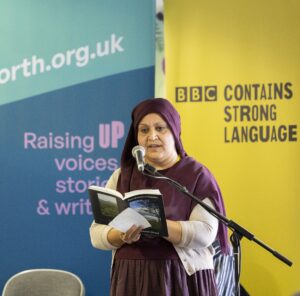
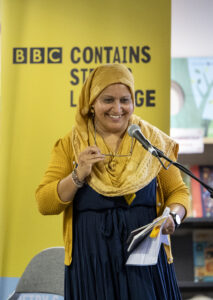
What? As part of Word Up North’s BBC Contains Strong Language 2025 Engagement Programme, Bradford poet Nabeela Ahmed immersed herself in three communities in the city, Wyke, Lasiterdyke and Holmewood, going undercover on a mission as ‘The Travelling Poet’ to explore what poetry means to the people there and to share and collect favourite verses and poems.
When? April to September 2025.
Where? The project worked from three libraries in Laisterdyke, Wyke and Holme Wood and connected with the communities within those areas.
Partners: Bradford Libraries, poet Nabeela Ahmed, artist Scott Walker from Doodlejam, and The Broadway Shopping Centre.
Our Aims
Working with Bradford Libraries, we focused on three areas where the libraries service wanted to deepen their connection with their local communities. They also wanted to understand local people’s experience of, and relationship to, poetry with a view to promoting and developing their poetry resources and activities.
Many people feel poetry isn’t for them. Some enjoy poetry but don’t have time to think about it amid the demands of their everyday lives. Others are keen writers of poetry but lacking outlets and networks in which to share their interest. We wanted to start a conversation: To make people think about what poetry means to them and what value it brings. By connecting with people’s memories and feelings about poems and taking conversations about poetry out into the streets and community spaces, we hoped to break down some of the conceptions that surround poetry and celebrate how accessible and relevant the art form can be.
What We Did
Poet Nabeela Ahmed spent the summer of 2025 immersed in three Bradford communities, Laisterdyke, Wyke and Holme Wood, going undercover on a mission as ‘The Travelling Poet.’
As she wandered the streets, visiting local libraries, community groups, cafés, shops and businesses, she met many Bradfordians (old and new!) and shared conversations about their lives, the areas they call home and their experiences of, and relationships with, poetry. She also conducted impromptu poetry workshops, responding to individuals and groups and sharing her love of the written and spoken word.
She explored what people think and feel about poetry, what poems they knew or remembered, and shared her favourite poetry collections and books. She collected quotes – people’s thoughts and reflections or snatches of their favourite poems (remembered or self-penned) – and helped people to write and share their own poetry, sometimes for the first time.
Talking about poetry can encourage nostalgia and connections, memories of the people who originally introduced you to the poem. Many participants found they remembered more poetry than they were expecting – from school, family or childhood.
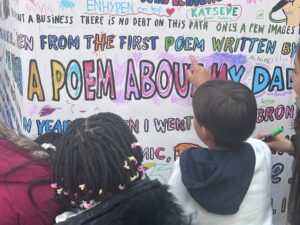
These collected conversations, interactions, poems and quotes were curated by Nabeela and used to create a unique piece of Doodle artwork by artist Scott Walker of Doodlejam. The result was an interactive drawing installation in The Broadway Shopping Centre during the BBC Contains Strong Language festival in September 2025. Aimed at families, the Bards of Bradford Doodle Wall enabled us to chart and share Nabeela’s journeys and conversations as well as encourage more poetry-based conversations and reflections as children and adults added their own responses to the wall in real time.
An accompanying exhibition was also created, showcasing Nabeela’s travels and some of the original poems collected from Bradford residents.
Collected Reflections
Here are some of the curated comments from those taking part in conversations and workshops collected for our Doodlewall installation:
‘I used to read poems and write them. I want to start again’.
‘I first wrote a poem in Year 11, when I went to the Bronte Museum and it was called ‘The Wedding Bonnet’.
“I liked poetry at school, my professor taught Persian and was good at explaining complex verses by Mirza Ghalib and Allamah Iqbal.’
‘I am new to the city. I like poetry. My wife takes me to the library where I borrow Urdu books.’
‘I remember war poetry. It was that guy, what was he called? Siegfried something.’
‘Heartbroken I wave you off, how will I stop this pain for I carry the loss of you in my heart…’ – a line from a poem by a participant of Wyke Knit & Natter group.
‘I listen to folk poetry, and they always taught me something about life, how to live better.’
‘Is slam poetry a thing? I’ve learnt a lot today!’
‘I love Ghani Khan. It’s sung quite a lot so you can just listen to it on You Tube and stuff.’
‘This love is not a business, There is no debt on this path, Only a few images enter our hearts’ – taken from a poem by a participant at Womenzone, Laisterdyke.
‘Poetry is a way to process. A way to heal.’
Impact & Feedback
The project created opportunities for rich and meaningful conversations about people’s personal connections to poetry and how it shapes memories, experiences, and relationships. Nearly everyone we engaged with had a poetry recollection—a moment when poetry had touched their lives in some way—and reconnecting with these memories was powerful. By going out into communities, the project broke down many of the usual barriers to participation, enabling people to talk about poetry on their own terms and in their own way.
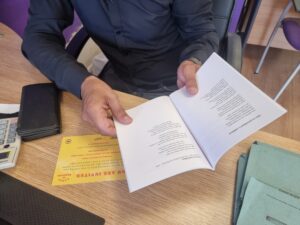
Taking poetry books into communities and inviting people to browse, reflect, and talk about what resonated with them led to many unexpected moments of connection. Participants were often surprised by how a particular text spoke to them and were eager to read it aloud or discuss it further. This approach created natural, organic ways for people to explore poetry without pressure or formality, allowing engagement to develop at a pace that felt comfortable and authentic.
We were also struck by the number of “secret writers” we encountered. Many participants had written poetry in the past, or were still writing, and were looking for ways to share and develop their work. Traditional writing or sharing groups can feel inaccessible for some, highlighting the need to explore alternative models of engagement. Offering impromptu poetry workshops, shaped by the interests and experiences of the community groups we visited, proved particularly effective. This responsive style of engagement—central to Nabeela’s practice and honed through her continuing work—enabled people to discover poetry, experiment with writing, and see their own creative voices as valid and valuable.
During the project Nabeela was able to support people to engage in writing for the first time. She also signposted them to library activities and groups that could support them to continue their interest. Many people did not know about or hadn’t thought to access their local library and were now keen to do so.
Reflections on the project were shared with Bradford Libraries service to help inform their work and offers moving forward.
Below are some extracts from Nabeela’ travelling diary charting her interactions:
‘…as I was getting into my car a young woman was sat with the full window open with her child. It was a hot day. She was looking at me, so I went up to her and introduced myself. She was happy to talk and said her husband had gone to post something. She hadn’t been to a library since she left Pakistan and now had two children. I told her about all the free activities for families in libraries and gave her the directions for City Library as she was from BD7. She said she loved poetry and remembered many names of poets from Pakistan.’
‘I was chatting to a barber in his shop. He hasn’t been to a library, so I told him about Laisterdyke as he has a child too. He writes poetry himself and has recorded one verse. He said he has a notebook full of poems but had a car accident (showed me the scar on his forehead) and can’t remember any of his latest work, but never forgets this first verse he wrote years ago which he shared with me. I told him about Yorkshire Adabee Forum who host Urdu poetry events and Urdu/Shurdu at Chaiwala and the open mics at City Library. He took photos of them all from my phone.’
As ‘The Travelling Poet’, I’ve had the opportunity to carry poetry books with me around Bradford and introduce people to these amazing artists. Many people who have never looked at poetry since school are in awe to hear contemporary poets talking about things that affect their lives today and don’t want to put the books down!’
Feedback from participants and partners:
‘Nabeela was absolutely brilliant and it was a good introduction to poetry for all of us. When she spoke to me the first time and said what she was going to do I have to admit that I wasn’t overly enamoured and didn’t think it would work with our group but when she did what she did, it was wonderful to see everyone sitting so quietly and listening and I really think it’s going to open up opportunities for some of the group now.’ – Workshop participant, Holmewood
‘The project was a brilliant way to get people talking and thinking about poetry and signposting them to library activities and offers. It also helps us think about what kind of activities and offers we want to do in the future and that this kind of approach, going out into the community really works and really engages people.’ – Head of Service, Bradford Libraries
This project was delivered as part of the BBC Contains Strong Language Bradford 2025 Engagement Programme. It was produced by Word Up North in partnership with the BBC and Bradford 2025 UK City of Culture. BBC Contains Strong Language Bradford 2025 was funded by Arts Council England and Bradford 2025.